
Feed Mill Process
Pre-Cleaning & Dust Collection
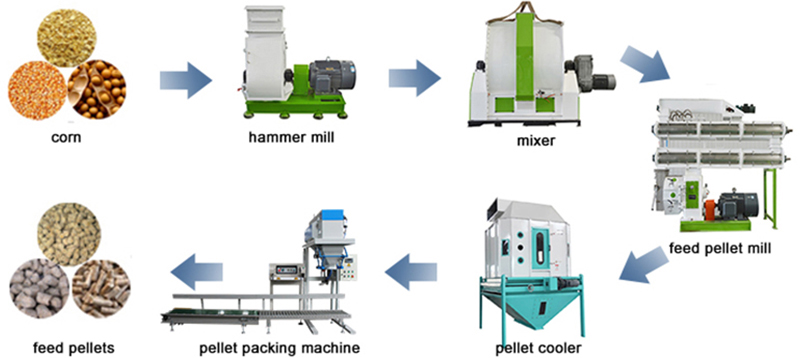
The first step in the pelleting process involves conveying raw ingredients from bulk silos or godowns to the batching bins. At this stage, it is essential to remove oversized foreign materials, iron particles, and other impurities that may adversely affect the functioning of slide gates, gravity feeders, screw feeders, or downstream equipment.
Pre-cleaning systems generally consist of rotary sieves, jute removers, magnetic separators, and dust collection units. In fully automatic feed mills, the system is designed to ensure continuous and efficient cleaning at maximum material flow rates.
Batching
Batching, also known as proportioning, refers to the automatic weighing of various raw materials as per the feed formulation to produce a single batch. Modern feed mills incorporate multiple silos of suitable capacity based on the plant output. These silos are equipped with gravity or screw feeders to ensure controlled discharge into the weigh bins installed below.
Typically, two sets of silos are provided—one for major ingredients and another for minor ingredients. The discharge from both weighing systems is directed into a common surge bin for further processing. To prevent material bridging or jamming, bin vibrators or shaking devices are installed where required.
The weighing operation is controlled by an electronic system based on PLC or microprocessor technology and can be operated through a computer interface. The system records complete batch data, including over- or under-weight variations, and generates reports on a batch-wise, shift-wise, daily, weekly, and monthly basis.
Key features of an efficient batching system include:
- Accurate weighing within a specified time to meet plant capacity
- High reliability with fully automatic operation
- Provision for manual operation in case of automation failure
Grinding
Grinding is carried out after batching to reduce raw materials to the desired particle size. Fine grinding increases the surface area of the material, allowing better exposure to heat and moisture during conditioning, which aids in effective gelatinization.
Grinding and pelleting are the two most energy-intensive operations in a feed mill. Efficient grinding with minimum energy consumption helps reduce overall power costs and improves pellet quality while lowering energy demand during pelleting.
Mixing
Uniform mixing of macro and micro ingredients is critical for producing nutritionally balanced and high-quality feed. A well-designed mixing system should ensure:
- Achievement of a low coefficient of variation (CV) within minimum mixing time
- Efficient discharge with minimal residue left inside the mixer
- Leak-proof gates to prevent material carryover into the next batch
Conditioning & Pelleting
Conditioning involves the addition of heat and moisture to the mixed feed to achieve proper gelatinization and make the material pliable for pelleting. An ideal conditioning system should:
- Increase temperature and moisture through direct or indirect heating
- Provide sufficient retention time for effective conditioning
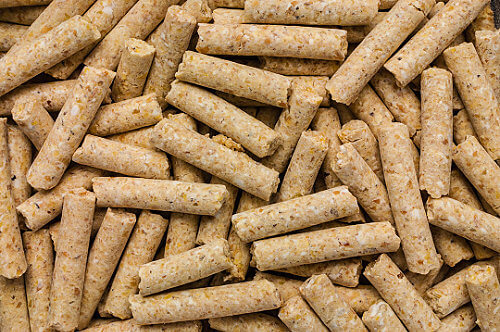
After conditioning, the feed is passed through a pellet mill, where rollers force the material through a die, converting it into pellets. Pellet mill output and pellet quality depend on several factors, including:
- Grinding quality
- Conditioning efficiency
- Feed formulation (oil, protein, fiber content, etc.)
- Die design and configuration
Crumbling
Crumbling is the process of breaking cooled pellets into smaller, uniform particles suitable for young chicks. If crumbling is not required, the product can bypass the crumbler and exit directly. A well-designed crumbler should: Produce uniform crumb size across the entire roll width Minimize fines generation Allow equal and precise gap adjustment on both sides of the rolls
Screening
The product exiting the crumbler—either pellets or crumbs—is screened to separate fines and oversized particles. Single-deck screeners remove fines only, while double-deck screeners remove both fines and oversize material. Oversized particles are returned to the crumbler, while fines are recycled back to the pelleting system for reprocessing.
Bagging
After screening, the finished feed is packed into bags. In small to medium-capacity plants, bagging may be performed manually. For higher production capacities, electronic bagging machines are recommended.
Electronic bagging systems offer:
- High weighing accuracy
- Faster bagging rates
- Reduced labor dependency
“The above information is based on data collected from existing customers and publicly available internet sources and is provided solely for reference purposes. As Global Namdhari Engineers (GNE) specializes exclusively in feed mill engineering, the company shall not be held responsible for any loss, damage, or consequences arising from the use of the above information.”